Your shampoo lists its ingredients.
Your moisturiser lists its ingredients.
Your toothpaste lists its ingredients.
In the UK, period products aren’t legally required to do the same.
We think that’s worth noticing.
It may sound surprising - especially when you consider how and where pads are used - but it’s not an oversight. It’s how the system currently works.
This is the regulation behind the Bloody Fine Print.
Pads are regulated, just differently.
To be clear: pads are regulated.
In the UK, they’re classed as general consumer products, not cosmetics or medical devices. That means they must meet certain safety standards around performance and manufacturing.
What they don’t have to do is publish a full ingredient list.
As long as those standards are met, brands are allowed to describe pads using broad, functional terms - language that explains what the product does, rather than what it’s made from.
And legally, that’s considered enough.
What “legally enough” looks like on packaging.
If you’ve ever read the side of a pad packet, the wording probably sounds familiar:
-
“Absorbent core”
-
“Odour neutralising technology”
-
“Moisture-proof backsheet”
-
“Adhesives”
These phrases are permitted because they describe function, not composition.
An “absorbent core” tells you the pad absorbs liquid.
It doesn’t tell you how it does that, or what materials are involved.
“Odour control technology” sounds reassuring, but doesn’t explain what’s being used to achieve it.
“Moisture-proof backsheet” tells you the outcome - not what that layer is made from, or how it behaves against skin.
And “adhesives” are rarely explained at all.
From a regulatory point of view, this meets the requirement. These materials aren’t necessarily unsafe by default - but the point is that consumers aren’t told they’re there.
From a transparency point of view, it leaves a lot unsaid.
What that language often covers
When researchers and independent organisations have analysed period products, they’ve found that behind those umbrella terms can sit things like:
-
Petroleum plastic-based super absorbent polymer.
-
Synthetic fragrances or additives intended to mask odour.
-
Plastic back layers designed to prevent leaks.
-
Synthetic bonding agents used to hold layers together.
Why is this level of non-disclosure considered acceptable here, when it wouldn’t be anywhere else?
Same product. Different standards.
If it wouldn’t be acceptable for skincare, or make-up to hide behind vague language, why is it normal for pads?
Why is the product that sits against your vulva for hours at a time held to a lower standard of transparency than your shampoo?
That question is at the heart of the Bloody Fine Print.
What transparency actually looks like
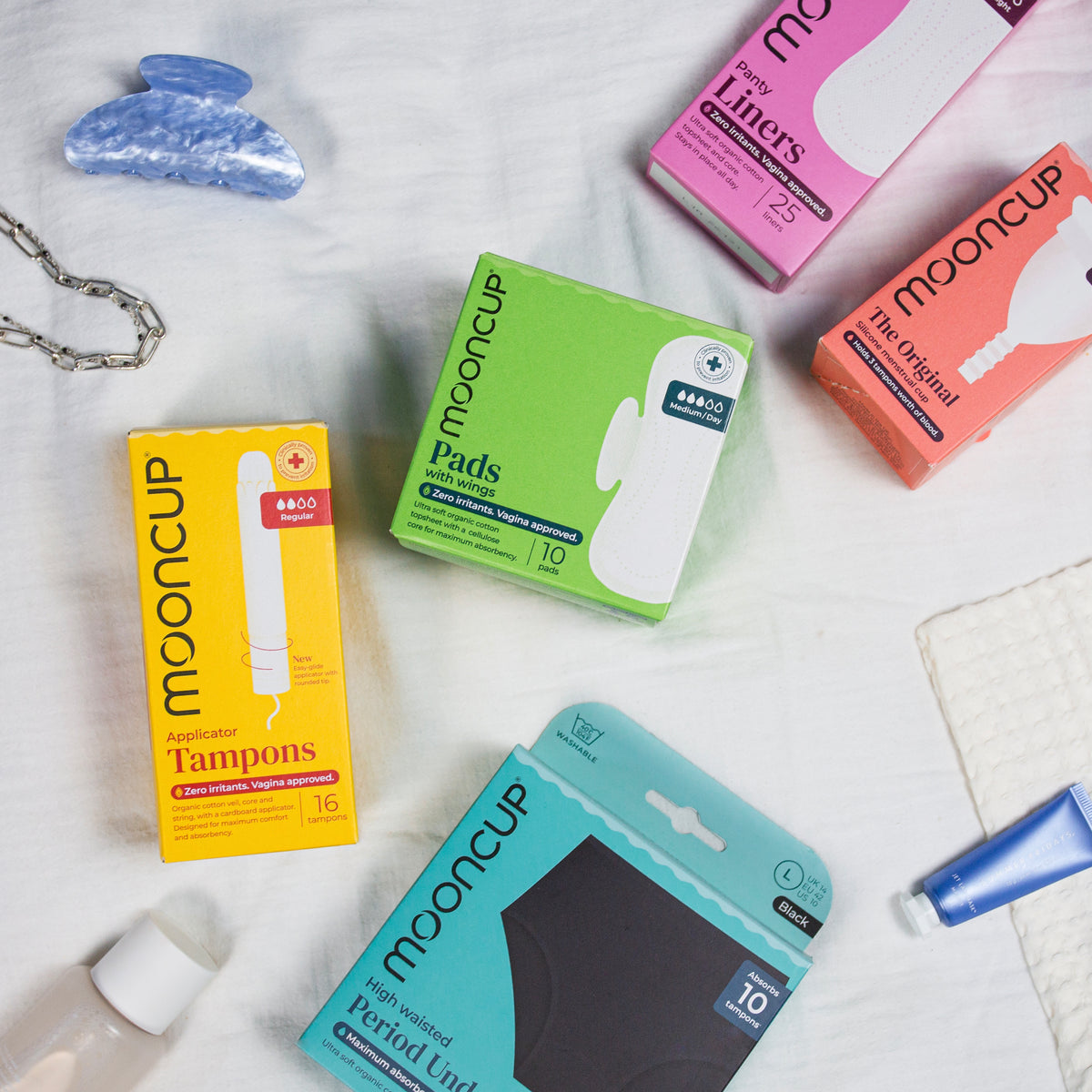
At Mooncup, we already list every ingredient in our pads.
Every layer. Every material. Every claim backed up.
Instead of umbrella terms, we tell you things like:
-
Organic cotton topsheet - GOTS-certified organic cotton that’s breathable and hypoallergenic.
-
Absorbent core - Maximum absorbency without petroleum plastic.
-
Non-toxic adhesive - Free from latex and rosin.
-
Cornstarch backsheet - leakproof and biodegrades within a year.
This isn’t because we’re legally required to. It’s because we think this should be the baseline.
Why we’re backing this with science
Bloody Fine Print didn’t start as a slogan.
It started as a question.
So we helped fund independent, peer-reviewed research that cut period products open and analysed what’s really inside them. Studies that looked beyond packaging language and into materials, residues, and chemical traces.
When people ask, “How do you know?”
This is the research we point to.
We believe transparency should be evidence-led, not anecdotal. And those facts matter when you’re talking about products used on bodies.
Changing expectations, not just rules
This campaign isn’t about saying pads are unsafe. It’s about saying that silence isn’t neutral.
That when a product category is allowed to operate with less transparency than almost anything else you use, it’s worth questioning why.
And that people who use pads deserve the same information they expect everywhere else.
Read the bloody fine print
We’re not asking you to memorise regulations. Or to blindly trust claims.
We’re asking you to notice.
To read what you’re given.
To question what’s missing.
And to expect better.
Because if it goes near your vulva, you deserve to know what it’s made of.
Blog disclaimer
Our blog is intended to share information and ideas around periods, health, and sustainability. While we do our best to keep content accurate and up to date, things can change over time. The information here is not intended as medical advice — for any health-related concerns, please consult a qualified healthcare professional. For more information on our claims, please see our Claims Page, and for the most up-to-date product information, please visit our Product Pages.