A handy explainer for anyone who buys, specs, or stocks period care.
Here's some regulatory trivia to bring to your next meeting: there's a material that farmers are being told to stop putting in soil, that is still sitting inside almost every period pad and liner you supply. It's called a superabsorbent polymer, or SAP, and if you're responsible for procuring period care, it's worth five minutes of your time.
So, what is a SAP?
In simple terms, it is a material that can absorb many times its own weight in liquid and turn it into a gel.
Most conventional SAPs are made from synthetic, fossil-fuel-derived polymers. They are used because they hold liquid securely, even under pressure.
That is why they’re everywhere - from nappies and incontinence products to cat litter and meat packaging. You might be surprised to learn they are also used in agriculture. SAPs have been mixed into soil to hold moisture and release it gradually - and it is this use case regulators have now stepped in on. Pictured: SAPs in a mainstream period pad
SAPs are out in agriculture
Here's the part that should raise an eyebrow. Conventional SAPs are petroleum-based, and they can take 500 or more years to break down. Left in soil or landfill, they don't disappear, they fragment into microplastics that persist in the environment more or less indefinitely.
Regulators took note of this.
Under new EU rules (Regulation (EU) 2024/2770, amending the Fertilising Products Regulation), SAPs used as soil conditioners are being phased out of agricultural use, with the restriction taking effect in 2028. The reasoning is straightforward: a material that doesn't degrade and ends up as microplastic in soil isn't one regulators want farmers relying on.
The environmental and health implications are simply not worth it.
So why is period care still using it?
Good question, and one the hygiene sector has actually had to answer. Back in 2023, when the EU brought in its broader microplastics restriction, period products (along with nappies and other absorbent hygiene products) were considered for inclusion, and ultimately exempted.
The logic: during use, the SAP in a pad is contained inside the product, so the risk of it escaping into the environment is considered low.
It's a reasonable argument on paper. It's a slightly less reasonable one once you factor in that an estimated 4 million pads and tampons are flushed down UK toilets every single day, at which point "contained" starts to feel a bit theoretical. With standard pads containing between 1 and 3.5 grams of superabsorbent polymer (SAP) each, this releases 4 to 14 tonnes of SAP into UK waterways daily. That means 1,460 to 5,110 tonnes of potential microplastic pollution per year in the UK alone.
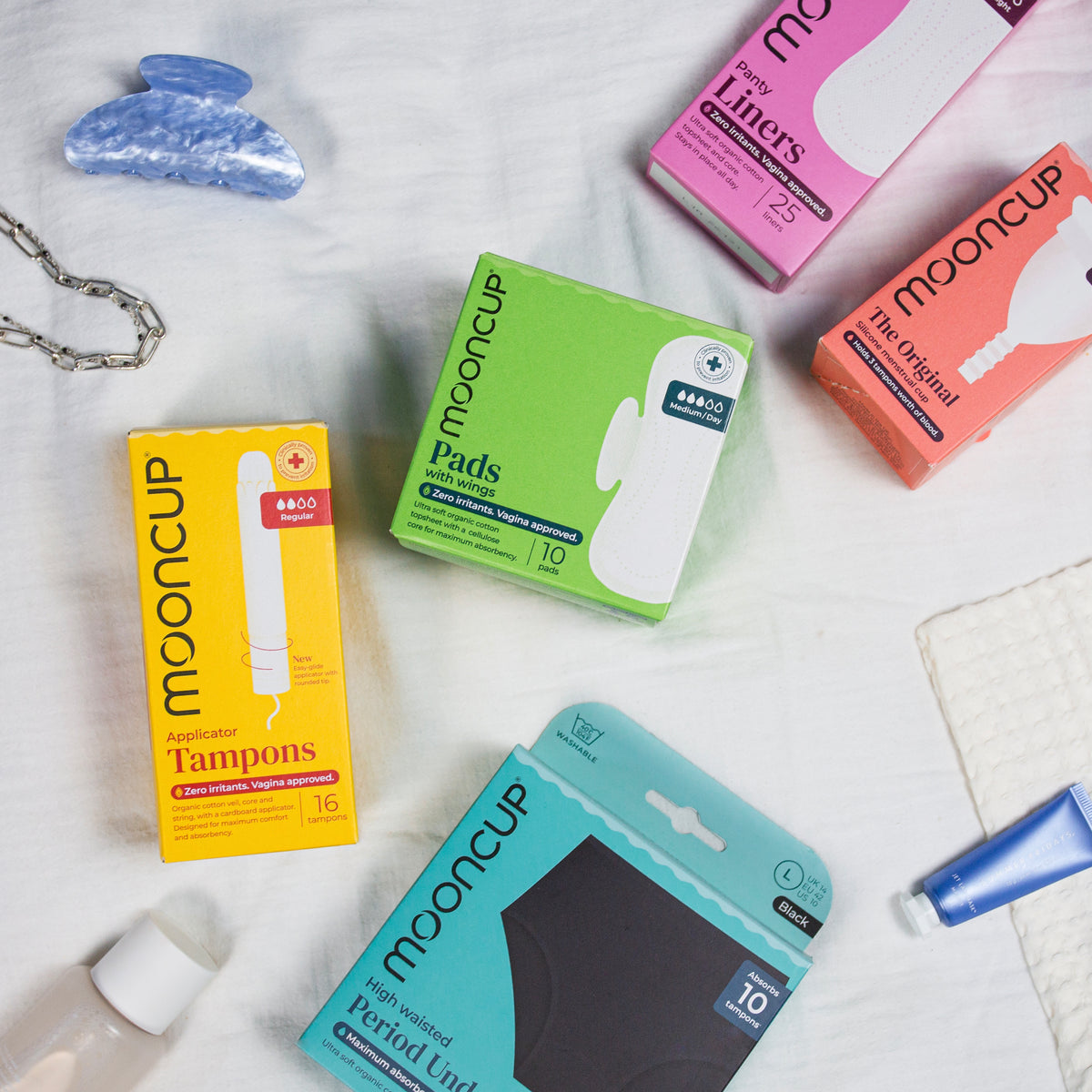
And contained or not, we don't think plastic at this scale is something to shrug off, because it isn't necessary. Alternatives exist. We'd know, because our products are made from them.

Pictured: what you’ll find in Mooncup period care
Why we think procurement teams shouldn't get too comfortable
To be clear: there is no confirmed date, proposal, or timeline for a period-care SAP ban. But there are a few reasons we think the current exemption might change in the future, and why it's worth FMs and procurement leads staying across this.
-
The exemption already comes with strings attached. Even derogated hygiene products now sit inside an annual emissions reporting obligation to the European Chemicals Agency (ECHA), starting from 2027. Regulators are actively building evidence on exactly how much of this material really does end up in the environment.
-
ECHA has said the text will evolve. Official guidance on the microplastics restriction explicitly notes the regulation is expected to change as implementation experience builds. That's not a period care-specific commitment, it's a general signal that today's exemptions are being treated as a live, reviewable position.
-
The direction of travel elsewhere is only one way. Agriculture has already lost its SAP exemption. Other sectors are seeing their exemptions narrowed as more data comes in. Sector-by-sector tightening is the pattern so far, not the exception.
None of that means a ban is imminent. But saying "SAPs are fine in period care because they're exempt" doesn’t feel right to us, based on everything we now know. The organisations buying period care in bulk are the ones who'll have to move fast if things change.
Getting ahead of it, rather than reacting to it
You don't have to wait for a regulator to make this decision for you.
SAP-free period care already exists and works. Mooncup disposable products like pads and tampons, and reusable products like pants and menstrual cups sidestep the entire SAP question because there's no absorbent gel core to begin with.
For any organisation specifying period care today, whether that's an FM contract, a gym chain, or a hospitality group, switching a portion of supply to SAP-free options isn't a compliance chore, it's just future-proofing a purchasing decision before someone else has to make it for you in a hurry. We are here when you’re ready.
Blog disclaimer
Our blog is intended to share information and ideas around periods, health, and sustainability. While we do our best to keep content accurate and up to date, things can change over time. The information here is not intended as medical advice — for any health-related concerns, please consult a qualified healthcare professional. For more information on our claims, please see our Claims Page, and for the most up-to-date product information, please visit our Product Pages.